
Graffiti Removal Guides Matched to Your Surface
These graffiti removal guides help you clean a tag off your own wall, fence or door without harming the surface underneath. Pick the one written for what was tagged: a general starting point, a masonry guide for brick and concrete, or a guide for Colorbond, metal and timber fences.
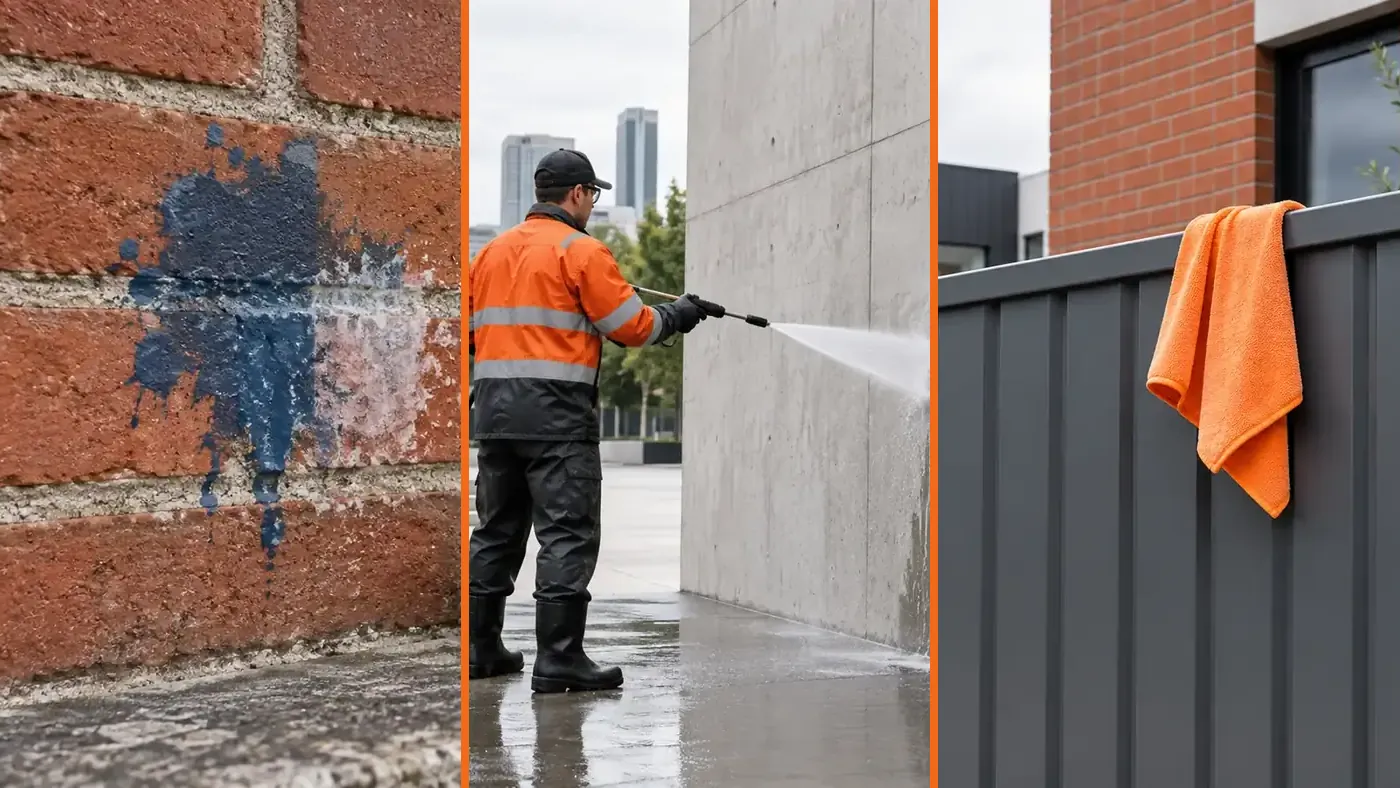
Every guide here starts from the same honest position: the best result is a wall that looks the way it did before anyone tagged it. That means a slow, gentle approach, a trial on a spot nobody will see, and knowing when to put the brush down. They're written for owners and managers in Melbourne, using products you can pick up at a hardware store.
The guides cover the surfaces people most often try to clean themselves. They leave out acid-etched glass, soft heritage stone and anything you'd need a ladder for, because those jobs go wrong quickly without trade gear. If that sounds like your wall, our page on graffiti removal in Melbourne explains how we take those jobs on instead.
Which graffiti removal guide do you need?
Choose by surface. Bare brick, blockwork, concrete paths and driveways belong in the masonry guide. Colorbond, roller doors, powder-coated gates and timber palings belong in the fences guide. For painted walls, paint on glass, or a surface you can't identify, begin with the general guide.
The general DIY guide
The foundation for the other two. It shows you how to identify the surface and the kind of paint, trial a remover, give it time, rinse without a pressure washer and tell when another round won't help. It also deals with painted walls, where a colour-matched repaint is often the better answer.
Read this ifit's your first attempt, the wall is painted, or you can't tell what it's made of.
- SkillBeginner to moderate
- Time30 to 90 min
- Steps7
Brick, blockwork and concrete
Masonry drinks paint in, so this guide is about patience rather than muscle. It explains why a gel outperforms a runny liquid on an upright wall, how plastic sheeting keeps the remover working, how to rinse without cutting the mortar, and why limestone and sandstone call for neutral, stone-safe products.
Read this ifa garden wall, letterbox pillar, retaining wall, footpath or driveway has been hit.
- SkillModerate
- Time1 to 3 hours
- Steps7
Colorbond, metal and timber fences
A baked factory finish is thin and scars easily, so this one is mostly about restraint: soapy water first, a hidden trial left overnight, light wiping and no solvents. Timber gets a separate method, sanding along the grain and re-staining, plus a check for roller doors that were painted after they went in.
Read this ifthe tag is on a fence, a garage or roller door, a gate or a steel letterbox.
- SkillBeginner
- Time20 to 60 min
- Steps6
None of the three recommends a particular brand of remover. Where a manufacturer has published its own cleaning advice, as BlueScope has for pre-painted steel, the relevant guide links to that source so you can read it for yourself.
Which guide matches your surface?
Find your surface in the table and follow the guide named beside it. Where the honest answer is a professional rather than a guide, the table says so, because a few surfaces are harmed faster by a well-meant attempt than by the graffiti itself.
| Surface | Guide to follow | Watch for |
|---|---|---|
| Face brick and blockwork | How to remove graffiti from brick | Mortar joints washing out under a close jet |
| Concrete walls, paths and driveways | Brick and concrete guide | Sealed slabs losing their sheen where cleaned |
| Limestone and sandstone, not heritage listed | Brick and concrete guide, stone section | Acidic products, which dissolve these stones |
| Painted render or painted brick | How to remove graffiti | Base paint softening, a sign to repaint instead |
| Colorbond fences and walls | How to remove graffiti from Colorbond | Solvents dulling the factory colour |
| Roller and garage doors | Colorbond and fences guide | Doors painted on site, which are much softer |
| Powder-coated gates and frames | Colorbond and fences guide | Abrasive pads polishing a shiny track |
| Timber palings | Colorbond and fences guide, timber section | Solvent pulling colour along the grain |
| Paint or marker on glass | General guide | Dry scraping, which leaves scratches |
| Acid etching on glass | No DIY guide: see etched glass restoration | Frosting that won't wipe off is damage, not paint |
| Heritage-listed brick or stone | No DIY guide: see masonry and heritage cleaning | Heritage Victoria expects a trial before full removal |
Not sure whether brick has been painted? Look inside a mortar joint or behind a downpipe. Painted brick usually carries the same colour into the joints, while bare brick shows grey or cream mortar between the faces. On glass, run a fingernail over the mark: anything you can feel catching on the edge is paint or marker, and a smooth frosted patch is etching.
What do all three guides agree on?
Four rules run through every guide: trial before you treat, start with the mildest product, let time do the work instead of pressure, and keep dirty water out of the drains. Stick to those and a small DIY attempt rarely makes things worse, even when it falls short.
- Before you start
Trial it somewhere hidden
A corner behind a bin or downpipe shows how the surface reacts. Judge it dry and in daylight, ideally the next morning.
- First attempt
Start mild, step up slowly
Soapy water, then a remover made for that surface, then a second round. Stronger chemistry comes last, if at all.
- While it works
Time, not force
Removers need their full label time to soften paint. Scrubbing harder or creeping the nozzle closer is how walls get scarred.
- Afterwards
Catch the runoff
Old towels, a tray or a bucket keep paint and remover out of the gutter, which drains to local creeks and the bay.
A fifth habit comes before all four: take a photo. Victoria Police encourages owners to record and report graffiti and to get it off quickly, and a dated picture helps police, insurers and anyone you later ask for a price. The runoff rule has a legal side too. Under EPA Victoria stormwater guidance, wash water and cleaning chemicals don't belong in a street drain, whatever the size of the job.
Which jobs aren't covered by a DIY guide?
Acid-etched glass, heritage or crumbling stone, and graffiti that is high, large or keeps returning. Each needs trade equipment, insurance and the judgement to stop at the right moment, so instead of a guide, each has a service page explaining how we approach it.
Etched shopfront glass
Etching acid eats into the pane, so there's no paint to dissolve. The options are polishing, film or a new pane, and only an inspection shows which one fits.
Acid-etched glass graffiti removalHeritage and soft stone
Sandstone, limestone and old lime mortar can be marked for good by a product that's harmless on brick. Registered places need a trial patch before full removal.
Brick, concrete and stone serviceHigh, large or repeat sites
Graffiti above ground reach, tags spread over several metres, and shopfronts hit every few weeks are cheaper to manage with a crew, a coating and a schedule.
Commercial response programs
Is a guide enough, or do you need a professional?
A guide is enough when the tag is small, fresh, within reach and on a surface covered here. Bring in a professional when any of those conditions isn't met, or when a careful first attempt has stalled, because repairing a scarred surface nearly always costs more than the clean would have.
| Factor | A guide is usually enough | Worth calling a professional |
|---|---|---|
| Size | One tag, roughly an arm's width | Several square metres, or more than one wall |
| Height | Reachable with both feet on the ground | Needs a ladder, scaffold or lift |
| Surface | Brick, concrete, painted walls, Colorbond, timber | Etched glass, heritage stone, crumbling mortar |
| Age of the paint | Days or a few weeks old | Months old, sun-baked, or already painted over |
| Earlier attempts | Nothing tried yet | Two careful rounds with no progress, or a marked trial spot |
| Urgency | Can wait for a quiet weekend | Offensive, on a shopfront, or facing customers today |
Price is part of the decision. Our page on graffiti removal cost sets out guide rates by surface, and because a minimum call-out applies, a single small tag is often worth trying yourself first. If you'd rather have a firm figure, get a quote by sending a photo along with a note of anything you've already tried.
What else do readers ask about these guides?
Are the guides useful for businesses and strata, or only homes?
Do any of the guides need a pressure washer?
Will my council remove the graffiti instead?
What if I follow a guide and the graffiti won't shift?
Tried a guide and the tag is still there?Send a photo and a note of what you used. We'll tell you what will come off, how, and what it costs.